








首次發現多環狀結構中的新行星 白矮星可促進生命開始?

2025-08-31 23:36:23 最後更新日期:2025-09-01 12:18:17
William Lam

香港輕新聞特約編輯,軍武 / 科普愛好者

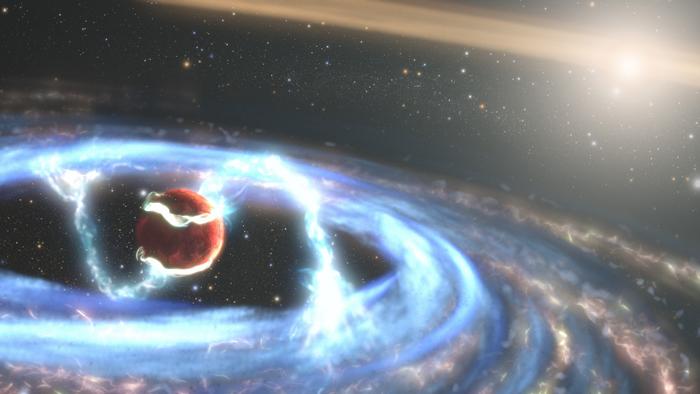
竹人一一弓Low R2畫家筆下,尚吸積階段且大量吞食母星塵埃盤物質的行星WISPIT 2b。其質量現在在5-6倍木星之間,但尚不知能吸積到多大才能停下來…(圖片來自連結)

天文學界中,除宇宙極早期事態和億光年為單位的大尺度結構外,系外行星研究也是顯學之一,不單相關研究很多,且更容易出現能修正/微調現有相關主流理論白研究成果。近一星期發表的兩項發現已是相關情況的典型例子。

This celestial object looks like a delicate butterfly. But it is far from serene. What resemble dainty butterfly wings are actually roiling cauldrons of gas heated to nearly 20 000 degrees Celsius. The gas is tearing across space at more than 950 000 kilometres per hour — fast enough to travel from Earth to the Moon in 24 minutes! A dying star that was once about five times the mass of the Sun is at the centre of this fury. It has ejected its envelope of gases and is now unleashing a stream of ultraviolet radiation that is making the cast-off material glow. This object is an example of a planetary nebula, so-named because many of them have a round appearance resembling that of a planet when viewed through a small telescope. The Wide Field Camera 3 (WFC3), a new camera aboard the NASA/ESA Hubble Space Telescope, snapped this image of the planetary nebula, catalogued as NGC 6302, but more popularly called the Bug Nebula or the Butterfly Nebula. WFC3 was installed by NASA astronauts in May 2009, during the Servicing Mission to upgrade and repair the 19-year-old Hubble. NGC 6302 lies within our Milky Way galaxy, roughly 3800 light-years away in the constellation of Scorpius. The glowing gas is the star's outer layers, expelled over about 2200 years. The "butterfly" stretches for more than two light-years, which is about half the distance from the Sun to the nearest star, Proxima Centauri. The central star itself cannot be seen, because it is hidden within a doughnut-shaped ring of dust, which appears as a dark band pinching the nebula in the centre. The thick dust belt constricts the star's outflow, creating the classic "bipolar" or hourglass shape displayed by some planetary nebulae. The star's surface temperature is estimated to be over 220 000 degrees Celsius, making it one of the hottest known stars in our galaxy. Spectroscopic observations made with ground-based telescopes show that the gas is roughly 20 000 degrees Celsius, which is unusually hot compared to a typical planetary nebula. The WFC3 image reveals a complex history of ejections from the star. The star first evolved into a huge red giant, with a diameter of about 1000 times that of our Sun. It then lost its extended outer layers. Some of this gas was cast off from its equator at a relatively slow speed, perhaps as low as 32 000 kilometres per hour, creating the doughnut-shaped ring. Other gas was ejected perpendicular to the ring at higher speeds, producing the elongated "wings" of the butterfly-shaped structure. Later, as the central star heated up, a much faster stellar wind, a stream of charged particles travelling at more than 3.2 million kilometres per hour, ploughed through the existing wing-shaped structure, further modifying its shape. The image also shows numerous finger-like projections pointing back to the star, which may mark denser blobs in the outflow that have resisted the pressure from the stellar wind. The nebula's reddish outer edges are largely due to light emitted by nitrogen, which marks the coolest gas visible in the picture. WFC3 is equipped with a wide variety of filters that isolate light emitted by various chemical elements, allowing astronomers to infer properties of the nebular gas, such as its temperature, density and composition. The white-coloured regions are areas where light is emitted by sulphur. These are regions where fast-moving gas overtakes and collides with slow-moving gas that left the star at an earlier time, producing shock waves in the gas (the bright white edges on the sides facing the central star). The white blob with the crisp edge at upper right is an example of one of those shock waves. NGC 6302 was imaged on 27 July 2009 with Hubble's Wide Field Camera 3 in ultraviolet and visible light. Filters that isolate emissions from oxygen, helium, hydrogen, nitrogen and sulphur from the planetary nebula were used to create this composite image. These Hubble observations of the planetary nebula NGC 6302 are part of the Hubble Servicing Mission 4 Early Release Observations.蝴蝶星雲的韋伯拍攝照片,中間較窄的原因,只是有一圈較厚的塵埃雲圍著星雲的中心部(白矮星),令整個行星狀星雲形像變成左右大,中間小的外觀。(網絡圖片)

根據SPACE.COM報道,一群以蘇格蘭、英格蘭及美國天文學家組成的團隊,在利用韋伯望遠鏡研究蝴蝶星雲(NGC 6302,一個年輕行星狀星雲)時,發現一些有趣的現象。這星雲前身有可能是壽命很短(不足8千萬年)且已成為白矮星的大質量恆星。該行星狀星雲中發現不少的複雜有機分子如多環芳烴 (PAH),及相對更大的塵粒(矽酸鹽或石英顆粒),比周圍星際塵埃大數十倍。天文學家發現這些分子相對於一般星雲中的更複雜,且應該是由白熾狀態的年青白矮星高溫與強輻射所刺激生成。
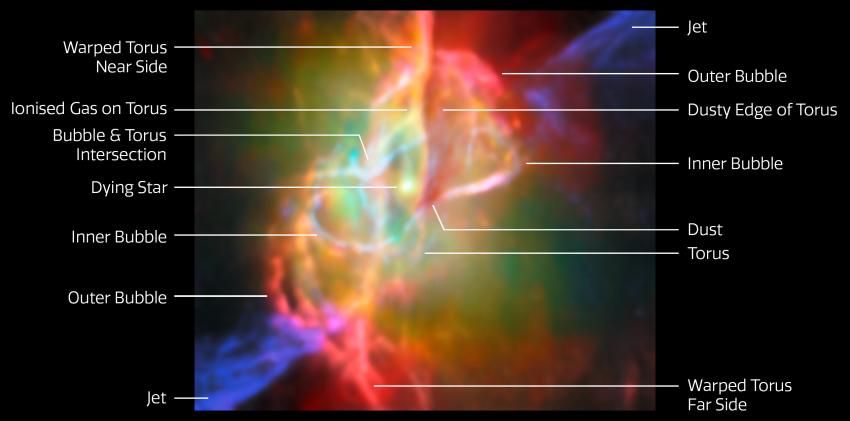
KB3vf4Aemv2Hkv24kephuV 850 80 韋伯望遠鏡拍到的影像,顯示蝴蝶行星狀星雲內部結構異常複雜,而且表面溫度達22萬度的白矮星也以其巨大的光度和熱量「改造」其氣殼和周圍塵埃雲的化學物質組成。(圖片來自(ESA/Webb))

過去一直認為由於噴發物質少得多也不夠猛烈,「臨終」時只能形成行星狀星雲及白矮星的小質量恆星(7倍太陽質量以下)在促進新恆星形成上貢獻有限,但這次發現,意味著當超新星爆發為塵埃雲貢獻大量重元素時,白矮星與行星狀星雲則提供更多複雜星際有機分子和更大的塵粒。前者有機會為生命提供所需複雜化合物,後者更有助塵埃雲初步凝結,為進一步塌縮及形成原恆星/行星提供更多機會。
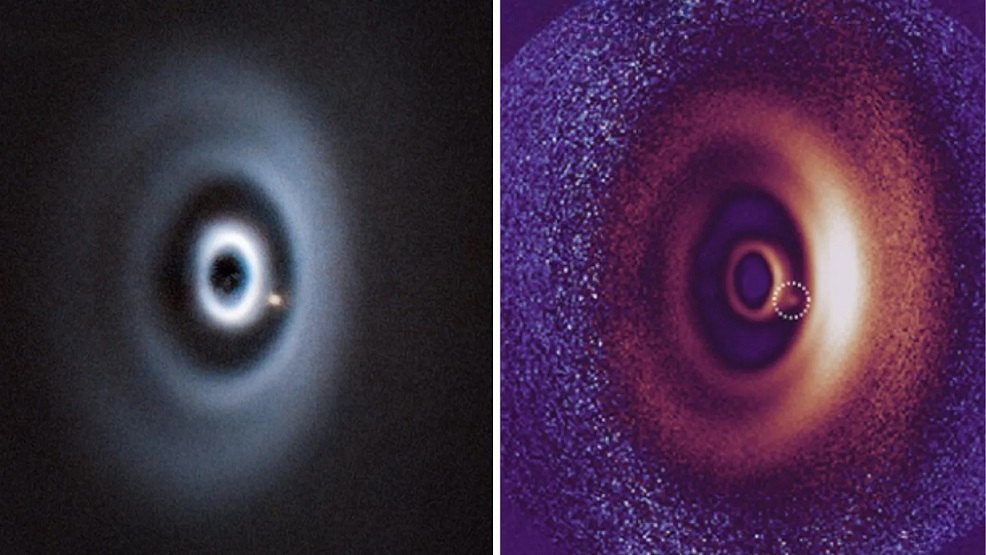
c8eTH00 80 1 歐洲太空天文台利用地面VLT望遠鏡進行拍攝,在四面具備光學自適應能力主鏡聯合拍攝並且可使用干涉技術,左為韋伯望遠鏡所拍可見光影像,右為紅外光影像。兩張不同光學波長的照片都拍攝到行星的存在,且該原行星盤的多環結構也清晰可見。(Image credit: ESO/R. F. van Capelleveen/C. Ginski/R. van Capelleveen et al.)

另方面,歐洲南方天文台研究人員利用智利的甚大望遠鏡(VLT)在天鷹座觀測的WISPIT 2恆星(一顆457光年外未開始核聚變點火的前主序星)上,發現呈多環結構的原行星盤,而且在可見光影像中就直接拍出一顆正在形成中的行星,這種光學發現行星一年很難發現幾顆,主要是因為要達到足夠可見光而被發現的話,需要距母恆星較遠,而且夠溫度之餘也要夠大,才能發出足夠的光/反射足夠的恆星光,並被地球上的大型望遠鏡陣列看到。

c8eTH00 A亞里桑那大學利用大雙筒望遠鏡及其高靈敏度中紅外攝影機拍到的影像,顯示在不同的紅外光波段下還拍到內側及後被稱為CCI的疑似行星,由於只在中紅外光發現,估計這時仍然是一團氣體雲,還未到行星階段。(圖片來自維基百科)

這WISPIT 2恆星的原行星盤也非常巨大,單可見光已有380多天文單位的半徑,已經是數一數二最大了,其他原行星盤可以大到接近1000天文單位,但多是紅外光甚至是射電望遠鏡發現的。被發現的極年輕行星位於距母星57天文單位的環縫上,質量大概是木星5-6倍之間,而且由光學和紅外照片判斷,似乎仍在吸收環內的物質。另外原行星雲還有四環結構,還未計算因解像度不足而無法觀測的內環,這裏可能已有四個行星在形成中,而就紅外光照片可見,除了該行星外,事實上似乎還有個代號CC1的原行星或氣體團在形成中。
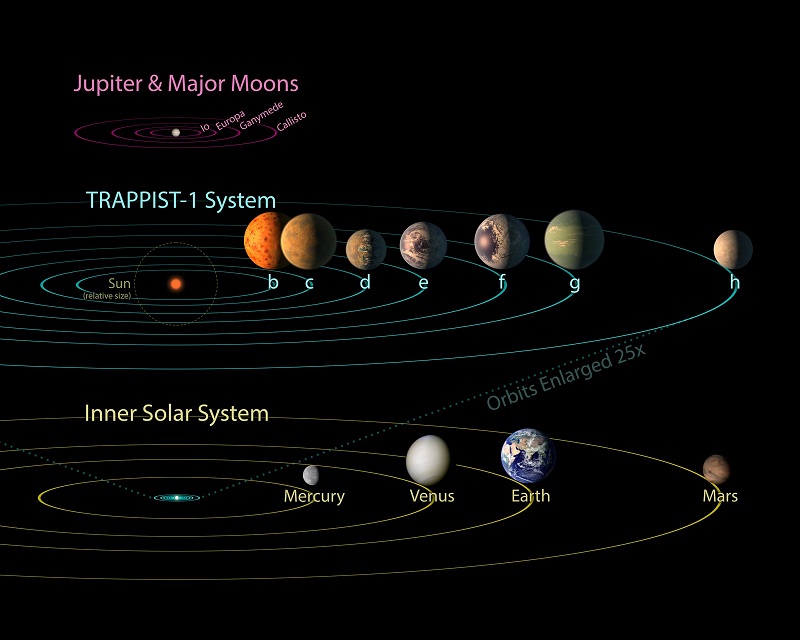
ssc2017 01g現時系外行星大部分都有很窄的軌道,少數的距離母星卻甚遠且普遍質量相當巨大,像太陽系的「適中距離」,在歷年行星發現上似乎比較少見,差異也很驚人。。

這行星系似乎還在很早的發展階段,母星本身也只比太陽稍為大8%左右,原本預期的行星後期重轟炸期或可能存在的外行星內移階段也未開始,但這似乎也反映宇宙中行星系統的普遍範式:不是極度密集(由一天文單位到0.1天文單位內),就是極度疏開(遠至10-30天文單位以外),距離規模和太陽系相約的「適中」倒相當少見。

發佈於 科學新知
By 2025-08-31

手機分享本文: